How to learn English from scratch: an honest guide from a teacher
How to learn English from zero with method and consistency: the 4 skills, how long it takes, a study routine and common mistakes. By a teacher since 2014.
In this article
- Can you learn English on your own?
- How long does it take to learn English?
- What are the 4 skills of English?
- How to learn English from scratch: step by step
- How much time a day should you study English?
- Free resources I recommend
- The mistakes that slow learners down the most
- Common hurdles for Portuguese speakers
- When is it worth having a teacher?
- Frequently asked questions
If you want to know how to learn English, here is the short answer: daily contact with the language, active practice from the very beginning and consistency over months, not days. There is no magic formula, no miracle course and no “fluent English in 30 days”. There is method, effort and time.
I have been teaching English since 2014 and have worked with more than 1,000 students, from children to people over 60. In this guide I bring together what research on learning shows and what I see working in practice, so you can start from scratch the right way.
Can you learn English on your own?
Yes, and many people start that way. On your own you can build vocabulary, train your ear, read better and better and even write. There is plenty of free, high-quality material for all of that (I list some further down).
Two things are hard to do alone: speaking with confidence and noticing your own mistakes. For those, you need someone on the other side: a teacher, a study partner or a conversation group.
I always say that 70% of learning depends on the student. With or without a teacher, you are the one who makes English happen, through what you do between one class and the next.
How long does it take to learn English?
This is the question I hear the most, and the honest answer is: it depends on where you start, your pace and how much contact you have with the language outside your study time. But there is a useful reference.
Cambridge English estimates how many guided learning hours (lessons and supervised study) it takes to reach each level of the Common European Framework of Reference (CEFR), the scale used around the world to measure language proficiency:
| Level | What you can do | Hours, from zero |
|---|---|---|
| A1 | Introduce yourself, answer questions about yourself and understand simple everyday phrases spoken slowly. | 90 to 100 |
| A2 | Handle simple, routine situations: shopping, directions, talking about your family and job. | 180 to 200 |
| B1 | Deal with most situations while travelling, describe experiences and explain plans and opinions. | 350 to 400 |
| B2 | Talk fluently and spontaneously with native speakers and understand complex texts in your field. | 500 to 600 |
| C1 | Use English flexibly at work and in your studies, understanding long texts and implicit meaning. | 700 to 800 |
| C2 | Understand virtually everything you hear or read and express yourself precisely in complex situations. | 1,000 to 1,200 |
Doing the maths: with 30 minutes a day, every day, you add up to about 180 hours in a year. That is roughly the path from zero to A2. Reaching B2 at that pace takes a few years.
Sounds like a lot? That is why I don't promise miracles. The good news is that you don't have to wait until you are “fluent” to use English: at A2 you can already get by on a trip, and every hour of series, music or conversation outside your study time counts too. Cambridge itself points out that exposure outside lessons changes how long it takes.
Not sure what your level is? EF SET is a free online English test that places you on the CEFR scale.
What are the 4 skills of English?
These are the four skills you need to develop. Two are input skills, where you receive the language, and two are output skills, where you use it:
- Listening: understanding spoken English at real speed and in different accents.
- Reading: understanding texts and, as a bonus, picking up lots of vocabulary.
- Speaking: communicating out loud, with clear pronunciation and without freezing.
- Writing: organising your ideas in writing, from a text message to a work e-mail.
In my classes I work on all four together, because each one feeds the others: what you hear becomes material for speaking, and what you read becomes material for writing. People who only study grammar, or only watch series, end up with half an English.
How to learn English from scratch: step by step
1. Decide why you want to learn
Work, travel, studying abroad, an exam, talking to friends from other countries? Your goal decides what to study first. If you are going to travel, you need airport, hotel and restaurant English. If you want to grow in your career, you need meetings, e-mails and interviews. Write your reason down: it is what will keep you going on the days you don't feel like studying.
2. Start with the most common words
You don't need thousands of words to start. According to data from the Oxford English Corpus, the 100 most frequent words make up about half of all written English. The top ten are: the, be, to, of, and, a, in, that, have and I.
Along with them, learn the survival basics: greetings, numbers, days of the week, colours and the verbs that show up everywhere, like to be, to have, to do, to go, to like, to want and to need.
3. Learn whole phrases, not isolated words
Memorising a single word on a list helps a little. Learning “I want to…”, “Can I have…?” or “How do you say… in English?” helps a lot, because you learn the word already working inside a sentence. These ready-made chunks are what let you speak without building everything in your head first.
A practical tip: whenever you write down a new word, write down the sentence where you found it. A few to start today:
- Could you repeat that, please?
- What does … mean?
- I'm learning English.
- I'd like a coffee, please.
4. Listen and read in English every day
Linguist Stephen Krashen became known for arguing that we acquire a language by taking in lots of content we can understand, with just a little that is new. In practice: choose things you understand almost entirely. If you understand nothing, the content is too hard for now.
At the start, go for material made for learners, like the short audio lessons from BBC Learning English. With series, think of it as a ladder: subtitles in your own language at first, then English subtitles and, one day, no subtitles. And pick topics you enjoy: it is much easier to stay consistent that way.
5. Speak from day one, even with mistakes
Nobody learns to speak just by listening. Start small: read out loud, repeat phrases right after the audio copying the rhythm and intonation (a technique called shadowing) and record a one-minute voice message about your day.
Making mistakes is part of the process. In 2014, when I worked at Disney for three months, using English every single day is what finally unlocked the language for me. Nobody gets unstuck by waiting to be perfect before they start.

6. Review at the right time (spaced repetition)
We quickly forget what we have seen only once. The fix is to review at intervals: the next day, a few days later, a week later. And to review by trying to remember before checking the answer, because that effort of pulling it from memory is what makes it stick.
A 2021 meta-analysis of 29 studies found a strong benefit from spacing out this memory practice instead of cramming it all at once. To do it without hassle, use Anki, a free flashcard app that works out when you should review each card. Put the whole sentence on the front, not just the word.
7. Get feedback
Without someone to point out what is wrong, mistakes become habits, and habits are hard to undo later. Ask someone to correct your writing, talk to people who already speak English and record yourself to compare with native pronunciation. This is where a teacher makes the biggest difference.
How much time a day should you study English?
For most people, 20 to 30 minutes a day, every day, works better than a marathon of hours at the weekend. It is the same principle as spaced review: the brain retains better what it sees a little at a time, often. Consistency beats intensity.
Here is an example week for beginners:
| Day | Focus | What to do (20 to 30 min) |
|---|---|---|
| Monday | Vocabulary | Learn 5 to 10 phrases for your goal and add them to Anki. |
| Tuesday | Listening | One short audio or video for learners, noting down new phrases. |
| Wednesday | Speaking | 5 minutes of shadowing and a 1-minute voice message about your day. |
| Thursday | Reading | A short text at your level and a review of your Anki cards. |
| Friday | Writing | Write 5 to 8 sentences about your week and ask for corrections. |
| Saturday | Fun | An episode of a series, or songs while following the English lyrics. |
| Sunday | Light review | Reread the week's notes and your hardest cards. |
You don't have to follow it to the letter. The secret is not breaking the chain: a little every day beats a lot every now and then. That is why I created English Rats, my students' consistency challenge: three times a year, study activities earn points, and the people who stick with English win prizes.
Free resources I recommend
None of these links are sponsored. They are reliable materials that work well for beginners:
- BBC Learning English: lessons, videos and the 6 Minute English podcast, great for training your ear with everyday topics.
- British Council LearnEnglish: grammar, vocabulary, reading and listening exercises organised by level.
- Cambridge Dictionary: a learner's dictionary with audio for British and American pronunciation.
- YouGlish: type a word and watch clips of real people saying it. Perfect for pronunciation.
- Anki: a free flashcard app with spaced repetition.
- Duolingo: good for building a daily habit at the start, but on its own it won't get you talking.
The mistakes that slow learners down the most
- Expecting fast results and giving up at the first plateau. Spending weeks feeling you haven't improved is normal, especially at intermediate level.
- Only studying grammar and never opening your mouth.
- Translating everything word for word from your language instead of learning how English says it.
- Being afraid of mistakes. If you wait to be perfect before you speak, you never will.
- Switching methods every week. Pick a path and give it time to work.
- Studying a lot once in a while instead of a little every day.
- Staying in your comfort zone: always the same subtitles, always the same kind of content.
Common hurdles for Portuguese speakers
Most of my students are Brazilian, and if you find English hard, you are not alone. In the EF EPI 2025, Brazil ranked 75th out of 123 countries, with 482 points, in the low proficiency band. And according to the British Council, only 5% of Brazilians speak English and just 1% are fluent.
In class, these are the points I work on most with Portuguese speakers:
- Sounds that don't exist in Portuguese, like the “th” in think and this, and the difference between short and long vowels (ship and sheep).
- The extra “ee” sound at the end of words. Portuguese speakers tend to say “dog-ee” instead of dog and “Facebook-ee” instead of Facebook.
- False friends: actually means “in fact” (not “currently”), pretend means “fingir”, push means “empurrar”, library is “biblioteca” and parents are “pais”.
- Pronouncing -ed in the past: worked ends with a “t” sound, played with a “d” sound and wanted with “id”.
- Word order: in English the adjective comes before the noun, as in a red car.
When is it worth having a teacher?
A teacher isn't mandatory. But it makes a big difference when you:
- want to speak with confidence and need someone to really practise with;
- want to know what is wrong in your speaking and writing;
- need a plan for your goal instead of studying a bit of everything;
- have a deadline, like an interview, a trip or an exam;
- know that without a set commitment, you end up putting study off.
A teacher can't learn for you. But a teacher shortens the road, because they show you what to study, correct what you don't notice and don't let you stop. If you want to know what my classes are like, see what my students say.
Want to study with me?Live online English classes, designed around your goal.
Talk to meFrequently asked questions
What is the best way to learn English on your own?
Combine three things every day: listening to and reading content at your level, active practice (speaking out loud and writing) and reviewing vocabulary with spaced repetition. Twenty to thirty minutes a day already makes a difference. For speaking, find someone to talk to, because it is the hardest skill to practise alone.
Can you learn English fast?
You can move faster by studying more hours and getting more exposure to the language, but there is no shortcut. Cambridge English estimates about 200 guided learning hours to go up one level. Be wary of anyone promising fluency in a few weeks.
How long does it take to become fluent in English?
It depends on where you start, your pace and how much you use English outside your study time. From zero to B2, the level where you can talk comfortably about many topics, Cambridge estimates 500 to 600 guided learning hours. At 30 minutes a day, that takes a few years.
What are the 4 skills of English?
Listening, reading, speaking and writing. The first two are input skills; the last two are output skills. Ideally, you practise all four together.
What are the 20 most common words in English?
According to the Oxford English Corpus: the, be, to, of, and, a, in, that, have, I, it, for, not, on, with, he, as, you, do and at. The 100 most frequent words make up about half of all written English.
Is there a right age to learn English?
No. I teach children and students over 60. Age changes the way you learn, but it does not stop anyone. Adults often have a big advantage: a clear goal and the discipline to study a little every day.
Do apps work for learning English?
As a complement, yes. Apps help you build the habit and learn vocabulary, but on their own they rarely get anyone to hold a confident conversation. Use an app every day and save time for real listening, speaking and writing.
Sources
- Cambridge English — Guided learning hours (estimated hours per CEFR level)
- Council of Europe — Common European Framework of Reference (CEFR), global scale
- Latimier, Peyre & Ramus (2021), Educational Psychology Review — meta-analysis on spacing out retrieval practice
- Wikipedia — Most common words in English (Oxford English Corpus data)
- Stephen Krashen (1982) — Principles and Practice in Second Language Acquisition
- EF via PR Newswire (2025) — Brazil climbs six places in the global English ranking (EF EPI 2025, in Portuguese)
- British Council via Lingopass (2023) — 5% dos brasileiros falam inglês e 1% é fluente

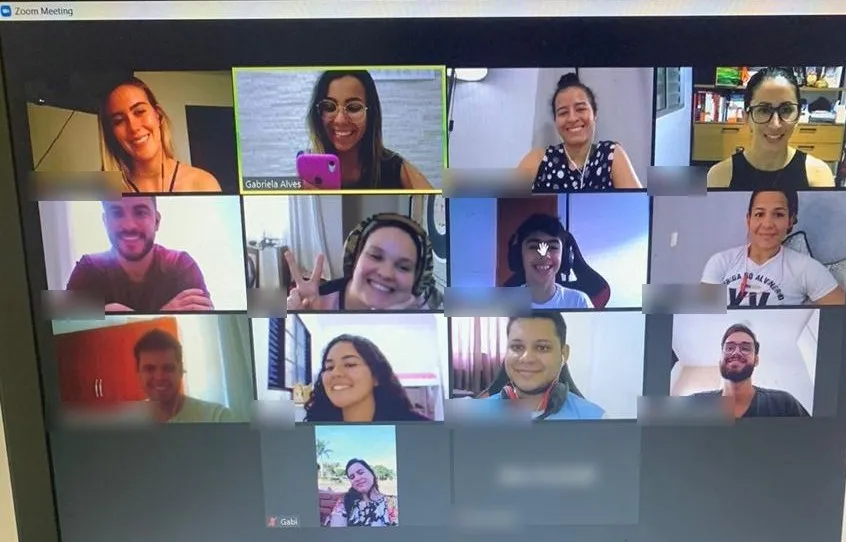
Teacher Gabriela Alves
I'm Gabi, and I've been teaching English for more than 12 years. I started teaching in 2014, worked at Disney for 3 months that same year and have since taught over 1,000 students, from kids to people over 60.
I don't do miracles. I do method, guidance and lots of practice.
If you're up for consistency, I'm up for walking that road with you. Tell me your goal and I'll show you where to start.
I want to study with you