Days of the week in English: pronunciation, abbreviations and usage
The days of the week in English in order, with audio, abbreviations, how to use on and at, and exercises with answers. By a teacher since 2014.
In this article
- What are the 7 days of the week in English?
- How to pronounce the days of the week
- Abbreviations of the days of the week
- How to use the days of the week in sentences
- In order: does the week start on Sunday or Monday?
- Why Thursday? Where the names come from
- Songs with the days of the week
- And the months of the year?
- Days of the week exercises (with answers)
- Frequently asked questions
The days of the week in English are Sunday, Monday, Tuesday, Wednesday, Thursday, Friday and Saturday. They always start with a capital letter, and to say when something happens we use the preposition on: on Monday.
It looks simple, and it is. But this is where my beginner students first stumble: Wednesday has silent letters, Thursday has the th sound, and Tuesday and Thursday get mixed up all the time. In this guide you will find how to pronounce each day (recorded in my own voice), the abbreviations, how to use them in sentences, where the names come from and exercises with answers.
What are the 7 days of the week in English?
Here they are in the order used by American calendars, starting on Sunday. Tap the button to hear me say each one:
| Day | Abbreviation | Type |
|---|---|---|
| Sunday | Sun | Weekend |
| Monday | Mon | Weekday |
| Tuesday | Tue | Weekday |
| Wednesday | Wed | Weekday |
| Thursday | Thu | Weekday |
| Friday | Fri | Weekday |
| Saturday | Sat | Weekend |
Two words you will hear all the time: weekdays are Monday to Friday, the working days, and the weekend is Saturday and Sunday.
How to pronounce the days of the week
Two rules apply to every day: the stress is always on the first syllable (MONday, TUESday, FRIday) and the ending day sounds like “day”. In fast speech, many native speakers shorten that ending to something like “dee”. The transcriptions between slashes are American pronunciation in the International Phonetic Alphabet.
- Sunday /ˈsʌn.deɪ/: it starts exactly like sun.
- Monday /ˈmʌn.deɪ/: the o sounds like the u in Sunday, “MUN-day”, not “MON-day”.
- Tuesday /ˈtuːz.deɪ/: the s sounds like z, “TOOZ-day”. In British English you will also hear “TYOOZ-day” or “CHOOZ-day”, according to Wiktionary.
- Wednesday /ˈwenz.deɪ/: the champion of tricky spellings. It is written with three syllables but said with two, because the first d and the second e are silent: “WENZ-day” (see the pronunciation on Wiktionary).
- Thursday /ˈθɝːz.deɪ/: make the th with the tip of your tongue between your teeth, letting the air out. It is not t, f or s. And the ur sounds like her.
- Friday /ˈfraɪ.deɪ/: the i sounds like “eye”, “FRY-day”.
- Saturday /ˈsæt̬.ɚ.deɪ/: three syllables, stressed on SAT. In American English, the t between vowels sounds almost like a quick d.
Tuesday or Thursday? Tuesday has tu; Thursday has th, it is Thor’s day. If it helps, remember that Thor is the god of thunder, and both words start with th.
Abbreviations of the days of the week
The three-letter ones are the most common: you will see them on calendars, planners, apps and watches. They can be written with or without a period (Mon. or Mon) and, on screens, usually in capitals.
| Day | 3 letters | Also | 2 letters | 1 letter |
|---|---|---|---|---|
| Sunday | Sun | — | Su | S |
| Monday | Mon | — | Mo | M |
| Tuesday | Tue | Tues | Tu | T |
| Wednesday | Wed | — | We | W |
| Thursday | Thu | Thur, Thurs | Th | T |
| Friday | Fri | — | Fr | F |
| Saturday | Sat | — | Sa | S |
On your watch: TUE is Tuesday and THU is Thursday, the most common mix-up. In one-letter abbreviations, T and S each appear twice, so it is the position in the week that tells you which is which.
How to use the days of the week in sentences
Always with a capital letter
In English, the days of the week are proper nouns. Write Monday, never monday, even in the middle of a sentence. The same goes for the months.
On before the day
- I have a meeting on Monday.
- My birthday is on Saturday.
On Mondays: things that happen every week
With the day in the plural, the sentence describes a habit: I go to the gym on Mondays means every Monday.
No on with last, next, this and every
- last Friday
- next Tuesday
- this Sunday
- every Wednesday
Wrong: See you on next Monday. Right: See you next Monday.
Parts of the day
On their own, parts of the day take in or at: in the morning, at night. But with a day of the week, everything becomes on: on Monday morning, on Sunday afternoon, on Friday night.
From Monday to Friday
From Monday to Friday works everywhere. In the United States, Monday through Friday is also very common, and it makes it clear that Friday is included, as the Oxford Learner’s Dictionaries notes.
On the weekend or at the weekend?
Both exist. According to the Oxford Learner’s Dictionaries, at the weekend is British English and on the weekend is more common in North America. To talk about every weekend, use on weekends: I visit my parents on weekends.
Asking what day it is
- What day is it today? — It's Thursday.
- What day is it tomorrow? — Tomorrow is Friday.
And the words that go with them: today, tomorrow, yesterday, the day after tomorrow and the day before yesterday.
Ready-to-use sentences
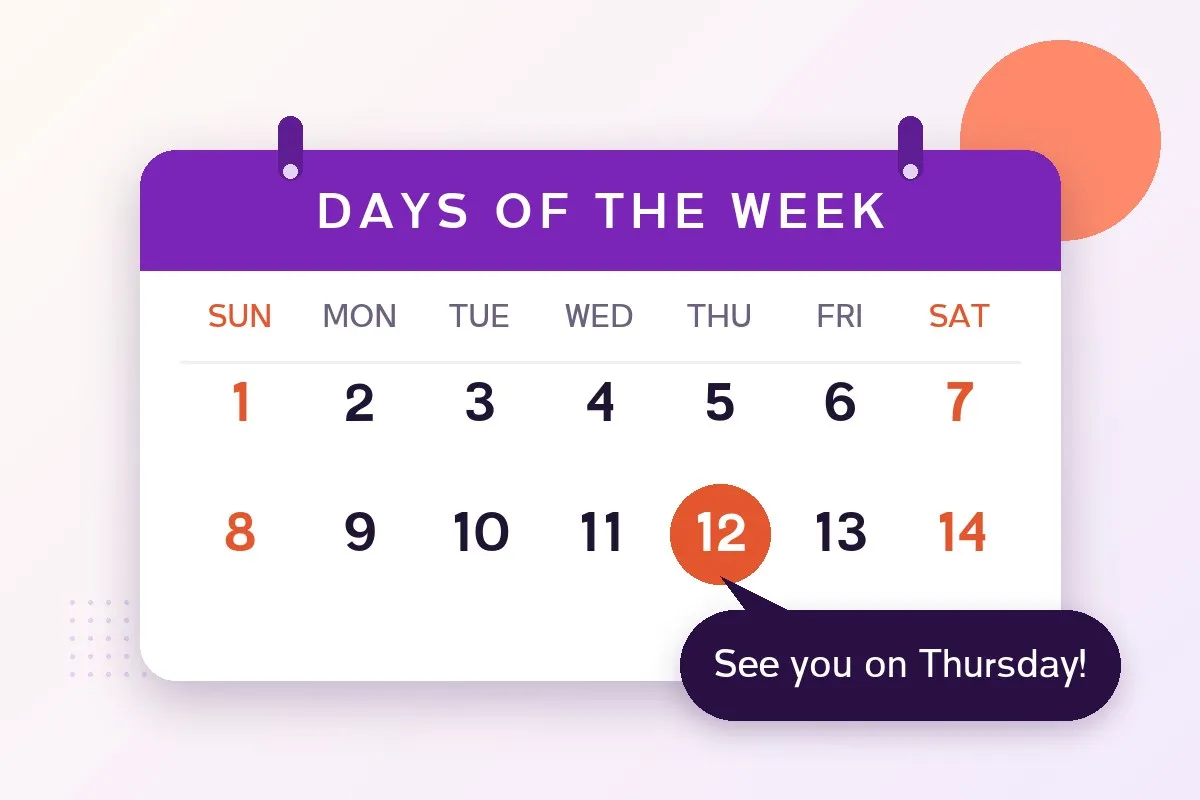
- See you on Thursday!
- The store is closed on Sundays.
- I work from Monday to Friday.
- We had a test last Wednesday.
- Are you free next Saturday?
- Thank God it's Friday! (The famous TGIF.)
In order: does the week start on Sunday or Monday?
It depends on the calendar. In the United States, calendars usually start on Sunday: Sunday, Monday, Tuesday, Wednesday, Thursday, Friday, Saturday. The international standard ISO 8601 treats Monday as the first day of the week, and many European calendars and planner apps follow that order: Monday, Tuesday, Wednesday, Thursday, Friday, Saturday, Sunday.
Why Thursday? Where the names come from
The Romans named the days of the week after the Sun, the Moon and five planets, which were also gods. The Germanic peoples, from whom English comes, kept the idea but replaced some of the Roman gods with their own:
| Day | Old English | Named after | Roman name |
|---|---|---|---|
| Sunday | Sunnandæg | the Sun | dies Solis |
| Monday | Mōnandæg | the Moon | dies Lunae |
| Tuesday | Tīwesdæg | Tiw (Týr), a Germanic god linked to war | dies Martis (Mars) |
| Wednesday | Wōdnesdæg | Woden (Odin) | dies Mercurii (Mercury) |
| Thursday | Þunresdæg | Thor (Þunor), god of thunder | dies Iovis (Jupiter) |
| Friday | Frīgedæg | Frigg, Odin’s wife | dies Veneris (Venus) |
| Saturday | Sæturnesdæg | Saturn | dies Saturni |
So Thursday is Thor’s day. And since I also speak Spanish, I always show my students that the Roman logic is still there: lunes (Moon), martes (Mars), miércoles (Mercury), jueves (Jupiter) and viernes (Venus).
A fun fact from Portuguese, my first language
According to Ciberdúvidas da Língua Portuguesa, Portuguese is the only Romance language that numbers its weekdays: Monday is segunda-feira, the “second day”, and so on until sexta-feira. The word feira comes from the Latin feria, a feast day, which the Church used to count the days without honouring pagan gods. The change is credited to Saint Martin of Dumio, in the 6th century, in the northwest of the Iberian Peninsula.
Songs with the days of the week
Music is a great way to remember the order and the pronunciation. For kids, two good options on YouTube:
- “Days of the Week” by Super Simple Songs: short and repetitive, perfect for little ones.
- “Days of the Week Song” by The Singing Walrus, in a “repeat after me” style.
For teenagers and adults, a few classics you may already know:
- “Friday I'm in Love” by The Cure: the lyrics go through every day of the week, great for practising the order.
- “Manic Monday” by The Bangles.
- “Ruby Tuesday” by The Rolling Stones.
- “I Don't Like Mondays” by The Boomtown Rats.
- “Sunday Bloody Sunday” by U2.
My tip: listen with the lyrics open, mark where each day appears and then sing along. It is shadowing with a soundtrack.
And the months of the year?
While you are here: the months also start with a capital letter. With months we use in (in March) and with dates we use on (on March 3rd). The month buttons use your phone or computer’s voice.
| Month | Abbreviation |
|---|---|
| January | Jan |
| February | Feb |
| March | Mar |
| April | Apr |
| May | May |
| June | Jun |
| July | Jul |
| August | Aug |
| September | Sep |
| October | Oct |
| November | Nov |
| December | Dec |
Days of the week exercises (with answers)
Try to answer before opening the answer. Recalling it yourself is what makes it stick.
Which day comes after Wednesday?
Show answer
Thursday.
Which day comes before Sunday?
Show answer
Saturday.
Fill in the blank: See you ___ Friday!
Show answer
On: See you on Friday! We use on before a day of the week.
Which is correct: “on next Monday” or “next Monday”?
Show answer
Next Monday. With last, next, this and every, we don’t use on.
Fill in the blank: I have English class ___ Tuesdays.
Show answer
On. The plural shows it happens every week.
Correct the sentence: “I work from monday to friday.”
Show answer
I work from Monday to Friday. Days of the week always take a capital letter.
Write the three-letter abbreviation of Thursday.
Show answer
Thu (you will also see Thur or Thurs).
Your watch shows WED. What day is it?
Show answer
Wednesday.
If today is Friday, what day is the day after tomorrow?
Show answer
Sunday: Friday, Saturday, Sunday.
How do you say it in American English: “___ the weekend”?
Show answer
On the weekend. In British English, at the weekend is more common.
Want to practise speaking?In my live online classes, vocabulary turns into real conversation.
Talk to meIf you are just starting out, read my guide on how to learn English from scratch, with a study routine and the mistakes that slow learners down. My projects show how my students practise outside class.
Frequently asked questions
What are the 7 days of the week in English?
Sunday, Monday, Tuesday, Wednesday, Thursday, Friday and Saturday. In English they always start with a capital letter.
Why is it called Thursday?
Because it is Thor’s day, named after the Germanic god of thunder. In Old English it was Þunresdæg. The Romans called it dies Iovis, Jupiter’s day, and the Germanic peoples swapped Jupiter for their own thunder god.
How do you pronounce Wednesday?
Like “WENZ-day”, with two syllables: the first d and the second e are silent. In IPA, it is /ˈwenz.deɪ/.
Are the days of the week capitalized in English?
Yes, always, even in the middle of a sentence: “See you on Monday.” Days of the week and months are treated as proper nouns.
What is the abbreviation for Thursday?
Thu is the most common, but you will also see Thur and Thurs. On watches and phones it usually appears in capitals: THU.
Is it “on the weekend” or “at the weekend”?
Both are correct. “At the weekend” is British English and “on the weekend” is more common in North America. For every weekend, say “on weekends”.
What is the first day of the week?
It depends on the calendar. In the United States, calendars usually start on Sunday. The international standard ISO 8601 treats Monday as the first day of the week.
What are the 12 months in English?
January, February, March, April, May, June, July, August, September, October, November and December. Like the days of the week, they always start with a capital letter.
Sources
- Wikipedia — Names of the days of the week (origins and the ISO 8601 standard)
- Wiktionary — Wednesday (British and American pronunciation)
- Wiktionary — Tuesday (British and American pronunciation)
- Oxford Learner’s Dictionaries — weekend (“at the weekend” and “on the weekend”)
- Oxford Learner’s Dictionaries — through (“Monday through Friday”)
- Ciberdúvidas da Língua Portuguesa — Origin of the Portuguese names of the days (in Portuguese)
- Ciberdúvidas da Língua Portuguesa — Os Dias da Semana, on Saint Martin of Dumio (in Portuguese)

Teacher Gabriela Alves
I'm Gabi, and I've been teaching English for more than 12 years. I started teaching in 2014, worked at Disney for 3 months that same year and have since taught over 1,000 students, from kids to people over 60.
I don't do miracles. I do method, guidance and lots of practice.
If you're up for consistency, I'm up for walking that road with you. Tell me your goal and I'll show you where to start.
I want to study with you