Level: Beginner · A1–A2
Numbers in English: how to say and write them, from zero to a billion
Numbers in English from 0 to a billion, with audio: writing them out, ordinals, thirteen vs thirty, years, dates and prices. By a teacher since 2014.
In this article
- Numbers from 0 to 20 in English
- Tens in English: from 20 to 90
- From 21 to 99: ten, hyphen, unit
- Thirteen or thirty? How not to mix up -teen and -ty
- Hundreds, thousands, millions and billions
- How to write any number in words, step by step
- Ordinal numbers in English
- Comma or point: decimals, fractions and percentages
- How to say numbers in everyday life
- Common mistakes with numbers in English
- How to practise numbers in English
- Numbers in English exercises (with answers)
- Frequently asked questions
The numbers from 0 to 10 in English are zero, one, two, three, four, five, six, seven, eight, nine and ten. From 13 to 19 they end in -teen (thirteen, fourteen…), the tens end in -ty (twenty, thirty, forty…) and from 21 to 99 you join the ten and the unit with a hyphen: twenty-one, forty-five. Then come hundred, thousand, million and billion.
Almost everyone can count to ten. The hard part is using numbers in real life: catching a price, writing down a phone number, saying a year or your age. That’s where I see my students stumble: thirteen turns into thirty, the decimal comma sneaks in where English uses a point, and “I’m 25” becomes I have 25 years. In this guide you’ll find every number with audio, the rule for writing any number in words, ordinals, and how to say dates, years, times, prices and phone numbers, with exercises at the end.
Numbers from 0 to 20 in English
These you need to memorise: each one has its own name. Tap the button to hear the pronunciation and repeat it out loud, because saying a word is different from recognising it.
| Number | In English |
|---|---|
| 0 | zeroor ohNote: zero has two names. Oh sounds like the letter O, and it’s very common in phone numbers: 555-0147 = five five five, oh one four seven. |
| 1 | one |
| 2 | two |
| 3 | three |
| 4 | four |
| 5 | five |
| 6 | six |
| 7 | seven |
| 8 | eight |
| 9 | nine |
| 10 | ten |
| 11 | eleven |
| 12 | twelve |
| 13 | thirteen |
| 14 | fourteen |
| 15 | fifteen |
| 16 | sixteen |
| 17 | seventeen |
| 18 | eighteen |
| 19 | nineteen |
| 20 | twenty |
Watch out for three of them: eleven (11) and twelve (12) follow no pattern, and three (3) is said with the tip of your tongue between your teeth. Without it, three turns into tree or free. From 13 to 19, the ending -teen is the same one you see in teenager: your teens are, literally, your -teen years, from 13 to 19.
Tens in English: from 20 to 90
The tens end in -ty. Some change the spelling of the number they come from, and that’s where spelling mistakes happen:
| Number | In English |
|---|---|
| 20 | twenty |
| 30 | thirty |
| 40 | forty |
| 50 | fifty |
| 60 | sixty |
| 70 | seventy |
| 80 | eighty |
| 90 | ninety |
- twenty (20): comes from two, but changes shape.
- thirty (30): from three, but spelt with ir.
- forty (40): no u, unlike four. Fourty is one of the most common spelling mistakes in tests.
- fifty (50): from five, but with an f. There is no fivety.
- eighty (80): eight + y, with just one t.
From 21 to 99: ten, hyphen, unit
Nothing else to memorise here, just one rule: the ten + a hyphen + the unit, with no “and” in between.
- 21 = twenty-one
- 35 = thirty-five
- 48 = forty-eight
- 67 = sixty-seven
- 99 = ninety-nine
The hyphen is part of the spelling: it joins the parts of whole numbers, as the Merriam-Webster guide to compounds explains. In speech it changes nothing: twenty-one sounds like a single word, stressed on ONE.
Every number from 1 to 100 in words
To look up whenever you need it. If you are just starting, read it out loud ten at a time.
- 1 one
- 2 two
- 3 three
- 4 four
- 5 five
- 6 six
- 7 seven
- 8 eight
- 9 nine
- 10 ten
- 11 eleven
- 12 twelve
- 13 thirteen
- 14 fourteen
- 15 fifteen
- 16 sixteen
- 17 seventeen
- 18 eighteen
- 19 nineteen
- 20 twenty
- 21 twenty-one
- 22 twenty-two
- 23 twenty-three
- 24 twenty-four
- 25 twenty-five
- 26 twenty-six
- 27 twenty-seven
- 28 twenty-eight
- 29 twenty-nine
- 30 thirty
- 31 thirty-one
- 32 thirty-two
- 33 thirty-three
- 34 thirty-four
- 35 thirty-five
- 36 thirty-six
- 37 thirty-seven
- 38 thirty-eight
- 39 thirty-nine
- 40 forty
- 41 forty-one
- 42 forty-two
- 43 forty-three
- 44 forty-four
- 45 forty-five
- 46 forty-six
- 47 forty-seven
- 48 forty-eight
- 49 forty-nine
- 50 fifty
- 51 fifty-one
- 52 fifty-two
- 53 fifty-three
- 54 fifty-four
- 55 fifty-five
- 56 fifty-six
- 57 fifty-seven
- 58 fifty-eight
- 59 fifty-nine
- 60 sixty
- 61 sixty-one
- 62 sixty-two
- 63 sixty-three
- 64 sixty-four
- 65 sixty-five
- 66 sixty-six
- 67 sixty-seven
- 68 sixty-eight
- 69 sixty-nine
- 70 seventy
- 71 seventy-one
- 72 seventy-two
- 73 seventy-three
- 74 seventy-four
- 75 seventy-five
- 76 seventy-six
- 77 seventy-seven
- 78 seventy-eight
- 79 seventy-nine
- 80 eighty
- 81 eighty-one
- 82 eighty-two
- 83 eighty-three
- 84 eighty-four
- 85 eighty-five
- 86 eighty-six
- 87 eighty-seven
- 88 eighty-eight
- 89 eighty-nine
- 90 ninety
- 91 ninety-one
- 92 ninety-two
- 93 ninety-three
- 94 ninety-four
- 95 ninety-five
- 96 ninety-six
- 97 ninety-seven
- 98 ninety-eight
- 99 ninety-nine
- 100 one hundred
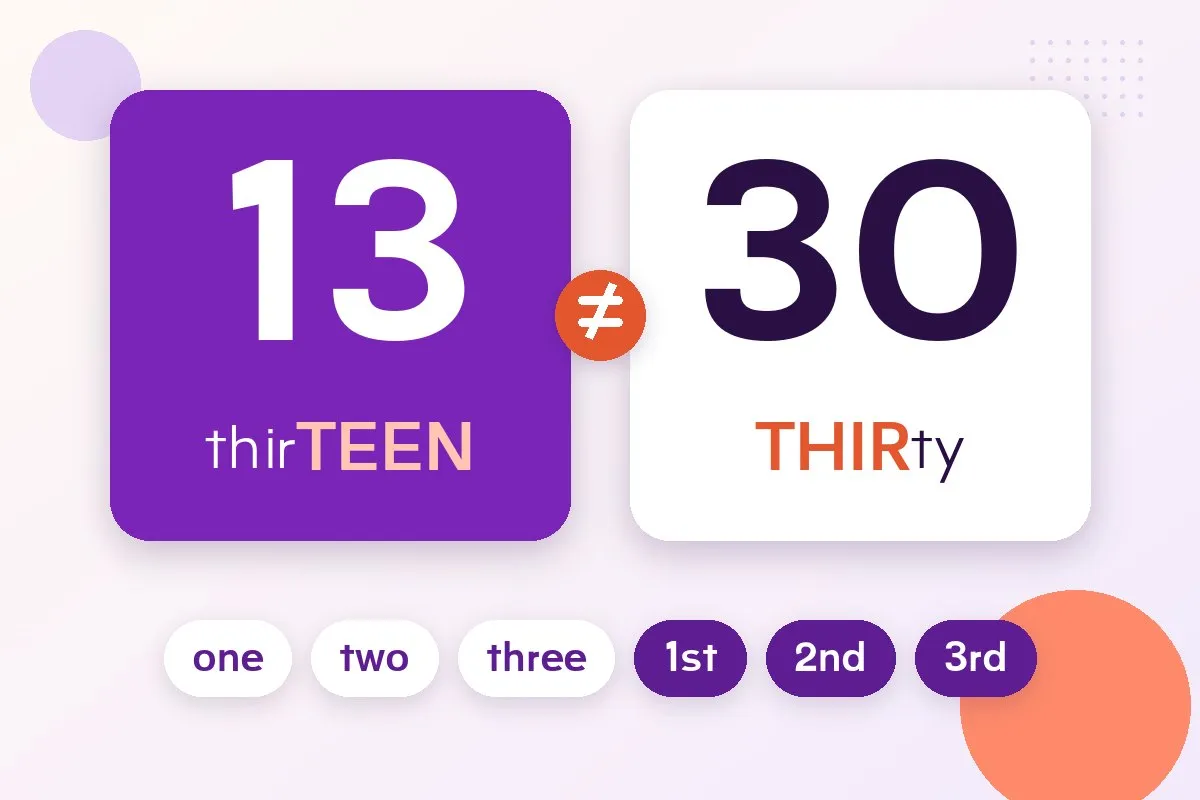
Thirteen or thirty? How not to mix up -teen and -ty
This is the number one listening mistake with numbers, and it happens even between native speakers. The main difference is the stressed syllable: numbers ending in -teen are stressed at the end, and tens ending in -ty are stressed at the start. The Oxford Learner’s Dictionaries transcribe thirteen as /ˌθɜːrˈtiːn/, stressed on teen, and thirty as /ˈθɜːrti/, stressed on thir. Listen to the pairs:
| Pair | -teen | -ty |
|---|---|---|
| 13/30 | thirteen | thirty |
| 14/40 | fourteen | forty |
| 15/50 | fifteen | fifty |
| 16/60 | sixteen | sixty |
| 17/70 | seventeen | seventy |
| 18/80 | eighteen | eighty |
| 19/90 | nineteen | ninety |
There’s a catch, though: when people count in a row (thirteen, fourteen, fifteen…) or when the number comes before a noun (thirteen dollars), many native speakers move the stress to the start. So the safest clue is the end of the word:
- -teen is long and ends with a clear n: “thir-teen”.
- -ty is short and has no n. In American English the t often sounds like a quick d: thirty sounds close to “thir-dy”, and forty to “for-dy”.
When in doubt, ask. Native speakers do it too with prices and times: “Sorry, is that one-three or three-zero?” Saying the digits one by one clears up any confusion.
Hundreds, thousands, millions and billions
Big numbers use four words: hundred, thousand, million and billion. In figures, English separates thousands with a comma, not a point.
| Number | In words |
|---|---|
| 100 | one hundred (or a hundred) |
| 200 | two hundred |
| 1,000 | one thousand (or a thousand) |
| 10,000 | ten thousand |
| 100,000 | one hundred thousand |
| 1,000,000 | one million (or a million) |
| 1,000,000,000 | one billion (or a billion) |
One hundred or a hundred?
Both mean 100. A hundred, a thousand and a million are more common in everyday speech. One hundred is more precise and is what you use in the middle of long numbers and in documents such as cheques and contracts.
No plural after a number
After a number, hundred, thousand, million and billion stay singular: two hundred, five thousand, three million. The plural with -s only appears for a vague amount followed by of, as the Oxford Learner’s Dictionaries show: hundreds of people, thousands of dollars.
The British “and”
In British English, and goes between the hundreds and the tens: 250 = two hundred and fifty. In American English it is often left out: two hundred fifty. The Britannica Dictionary, for example, lists a hundred one, with no and, as chiefly US. Both are correct and everyone understands both. And only comes before the last part of the number, never after thousand or million when a hundred still follows: 2,300 is two thousand three hundred.
Twelve hundred: counting in hundreds
In American English, numbers from 1,100 to 9,999 are often read in hundreds, especially prices and years: 1,200 = twelve hundred, 1,500 = fifteen hundred. One thousand two hundred is also correct.
How much is a billion?
Today, in both the United States and the United Kingdom, one billion is 1,000,000,000, a thousand million. The Oxford dictionary marks the British sense of “a million million” as old-fashioned. A million million is a trillion.
How to write any number in words, step by step
With the pieces above, you can write any number. The method:
- Split the number into groups of three digits, from right to left: 3,457 becomes 3 | 457.
- Read each group as a number from 1 to 999 and add the group word: three thousand, four hundred fifty-seven.
- Use a hyphen from 21 to 99 (fifty-seven) and, for British English, and before the last part.
- No -s on hundred, thousand or million.
| Number | In words |
|---|---|
| 85 | eighty-five |
| 342 | three hundred (and) forty-two |
| 1,005 | one thousand (and) five |
| 3,457 | three thousand, four hundred (and) fifty-seven |
| 15,300 | fifteen thousand, three hundred |
| 250,000 | two hundred (and) fifty thousand |
| 7,800,000 | seven million, eight hundred thousand |
Ordinal numbers in English
Ordinals show order or position: first, second, third. You’ll use them mostly in dates (May 1st), floors (the third floor) and rankings (first place). The short form joins the figure with the last two letters of the word: 1st (first), 2nd (second), 3rd (third), 4th (fourth).
| Short form | In words |
|---|---|
| 1st | first |
| 2nd | second |
| 3rd | third |
| 4th | fourth |
| 5th | fifth |
| 6th | sixth |
| 7th | seventh |
| 8th | eighth |
| 9th | ninth |
| 10th | tenth |
The rules for ordinals
- Only the first three are irregular: first, second, third. From 4 on, add -th: sixth, seventh, tenth.
- Some change their spelling: five becomes fifth, eight becomes eighth (one t), nine loses its e (ninth), twelve becomes twelfth, and the tens change y to ie: twenty becomes twentieth, thirty becomes thirtieth.
- In compound numbers, only the last part becomes an ordinal: 21st = twenty-first, 42nd = forty-second, 103rd = one hundred (and) third.
- Numbers ending in 1, 2 and 3 go back to st, nd and rd (21st, 32nd, 53rd), except 11th, 12th and 13th, which use th.
These are the ones you’ll use most in dates, up to the 31st:
| Short form | In words |
|---|---|
| 11th | eleventh |
| 12th | twelfth |
| 13th | thirteenth |
| 20th | twentieth |
| 21st | twenty-first |
| 22nd | twenty-second |
| 23rd | twenty-third |
| 30th | thirtieth |
| 31st | thirty-first |
Floors, centuries and kings
- Floors: careful with the first floor. According to Oxford, in American English it is the floor at street level; in British English that is the ground floor, and the first floor is the one above it.
- Centuries: English doesn’t use Roman numerals for them. The 21st century is the twenty-first century.
- Kings and queens: Elizabeth II is read Elizabeth the Second, with the before the ordinal.
Comma or point: decimals, fractions and percentages
Here’s a classic trap. In Brazil and much of Europe, the comma marks decimals and the point separates thousands. In English-speaking countries it’s the other way round: the point marks decimals (Oxford uses 0.61 to define decimal point) and the comma separates thousands, as the Britannica Dictionary writes 1,000:
| In Brazil | In English | How to say it |
|---|---|---|
| 1.500 | 1,500 | one thousand five hundred |
| 2,5 | 2.5 | two point five |
| 3,14 | 3.14 | three point one four |
| 0,75 | 0.75 | zero point seven five |
| R$ 1.234,56 | $1,234.56 | (see prices, below) |
After the point, digits are read one by one: 1.25 is one point two five, not “one point twenty-five”. The zero before the point is often dropped in speech (point seven five), and in British English you’ll also hear nought: nought point five, according to Oxford.
Fractions
Fractions use ordinals, with an -s in the plural: 1/3 = a third (or one third), 2/3 = two thirds, 3/5 = three fifths. The exceptions are half and quarter:
- 1/2 = a half (or one half). 1½ = one and a half.
- 1/4 = a quarter. In American English, a fourth is also common, according to Oxford. 3/4 = three quarters.
Percentages
25% = twenty-five percent. British English also writes per cent, as two words. And an expression you’ll hear a lot: I’m a hundred percent sure.
How to say numbers in everyday life
Age
In English, age goes with to be: I’m 25 or I’m 25 years old. To ask: How old are you? For an age range, use the plural of the tens: she’s in her thirties (between 30 and 39), as Oxford shows.
Phone numbers
Phone numbers are said digit by digit, with a short pause between groups. Zero usually becomes “oh”, like the letter O, a use Oxford lists. In British English, repeated digits can be said with double: Oxford gives the example two four double 0 for 2400.
- 555-0147 = five five five, oh one four seven.
- 555-0199 = five five five, oh one nine nine (or oh one double nine, in British English).
Years
Up to 1999, years are read in pairs. From 2000, both styles are used:
- 1998 = nineteen ninety-eight
- 1905 = nineteen oh five
- 2000 = two thousand
- 2008 = two thousand (and) eight
- 2010 = twenty ten or two thousand (and) ten
- 2026 = twenty twenty-six or two thousand (and) twenty-six
For decades, use the plural: the nineties (written 1990s). The preposition for a year is in: in 2026.
Dates
In dates, the day is said as an ordinal. The order depends on the country, and it causes real confusion. In the United States the month comes before the day; in the UK the day comes first. See the examples in Oxford (July fifth in American English, the fifth of July in British English) and the style guide of the ONS, the UK’s national statistics office, which writes 12 March 2014:
- American: July 4, 2026 or 7/4/2026. Said July fourth, twenty twenty-six.
- British: 4 July 2026 or 4/7/2026. Said the fourth of July, twenty twenty-six.
Careful with 03/04. For an American, it’s March 4th. For a British reader, or a Brazilian, it’s April 3rd. In emails and travel plans, write the name of the month and the problem disappears.
The prepositions: on for a date (on July 4th), in for a month or a year (in July, in 2026). The months are in my article on the days of the week and months in English.
Time
The simplest way is to say the numbers in order, and it works everywhere. In the United States the 12-hour clock is the norm, with a.m. (before noon) and p.m. (after noon): 15:00 is 3 p.m.
- 7:00 = seven o’clock
- 7:05 = seven oh five
- 7:15 = seven fifteen or a quarter past seven
- 7:30 = seven thirty or half past seven
- 7:45 = seven forty-five or a quarter to eight
Prices and money
In writing, the symbol comes before the number ($20), but in speech the currency comes after: twenty dollars. For prices with cents, people usually say the two numbers and skip the currency:
- $5.99 = five ninety-nine (or five dollars and ninety-nine cents)
- $0.50 = fifty cents
- $1,500 = one thousand five hundred dollars (or fifteen hundred dollars)
- R$30 = thirty reais (Brazilian reais)
When a number becomes an adjective with a hyphen, the noun stays singular: a ten-dollar bill, a three-hour class, a 25-year-old teacher.
The many names of zero
- zero: the standard, in maths, temperatures and everyday speech.
- oh: in phone numbers, years (1905) and times (7:05). And in 007: double oh seven.
- nought: British English, in maths and decimals (Oxford).
- nil: in scores, especially British football: four nil is 4–0 (Oxford).
- love: in tennis. 40–0 is forty-love.
Common mistakes with numbers in English
- I have 25 years. Correct: I’m 25 (years old). Age goes with to be.
- Two hundreds dollars. Correct: two hundred dollars. Hundred, thousand and million take no -s after a number.
- 2,5 for two and a half. Correct: 2.5 (two point five). In English, the point marks decimals.
- Fourty, nineth, twelveth. Correct: forty, ninth, twelfth.
- 21th and 22th. Correct: 21st and 22nd. The last digit decides.
- Thirteen and thirty sounding the same. Mark the stress: thir-TEEN, THIR-ty.
- Three sounding like “tree”. The th is made with your tongue between your teeth.
- A five-dollars bill. Correct: a five-dollar bill. Before a noun, no plural.
- Reading 03/04 without knowing where the date comes from. In the United States, the month comes first.
How to practise numbers in English
You learn numbers by using them, and they are everywhere. A few practices that work and fit into five minutes a day:
- Read the numbers around you out loud, in English: prices at the supermarket, car plates, bus times.
- Do number dictations with someone: one says a phone number or a price, the other writes it down, then swap.
- Practise the thirteen and thirty pairs with the buttons in this article. Record yourself and compare.
- Count backwards, or in threes. It takes you off autopilot.
- Listen to numbers in context: weather forecasts, sports scores and the news are full of them.
Little and often beats a lot once in a while: five minutes every day does more for your English than an hour of study every two weeks.
Numbers in English exercises (with answers)
Try to answer before you open the answer. Remembering on your own is what makes it stick.
Write in words: 47.
Show answer
Forty-seven. Forty with no u, and a hyphen before the unit.
Is thirteen 13 or 30?
Show answer
13. 30 is thirty, stressed at the start.
Write in words: 350.
Show answer
Three hundred (and) fifty. Hundred stays singular, with and in British English.
Write in words: 2,768.
Show answer
Two thousand, seven hundred (and) sixty-eight.
How do you say 4.75?
Show answer
Four point seven five. After the point, digits are read one by one.
Correct the sentence: “I have 30 years.”
Show answer
I’m 30 or I’m 30 years old.
Correct the sentence: “There were two hundreds people at the party.”
Show answer
There were two hundred people at the party. No -s after a number.
Write the ordinal of 22, in words and as a short form.
Show answer
Twenty-second (22nd).
How do you write the ordinal of 12?
Show answer
Twelfth (12th). The ve of twelve becomes f.
How do you say the year 1985?
Show answer
Nineteen eighty-five.
An American wrote 04/07 on an invitation. What’s the date?
Show answer
April 7th. In the United States the month comes before the day.
How would you say the phone number 555-0100?
Show answer
Five five five, oh one oh oh. In British English: five five five, oh one double oh.
Want to practise speaking?In my live online classes, numbers leave the list and turn into conversation: prices, dates, times and plans.
Talk to meKeep going with the days of the week in English, which complete the topic of dates, and thank you and you’re welcome in English. If you are just starting, my guide on how to learn English from scratch shows a study routine that fits real life. My projects show how my students practise outside class.
Frequently asked questions
What are the numbers from 1 to 10 in English?
One (1), two (2), three (3), four (4), five (5), six (6), seven (7), eight (8), nine (9) and ten (10). 0 is zero, and in phone numbers and years people also say “oh”, like the letter O.
How do you write the numbers from 1 to 100 in English?
From 1 to 20 each number has its own name (one, two… eleven, twelve… twenty). After that, the tens end in -ty (thirty, forty, fifty…) and from 21 to 99 you join the ten and the unit with a hyphen: twenty-one, forty-five, ninety-nine. 100 is one hundred. The full list from 1 to 100 is in this article.
How do you write 1000 in English?
One thousand, or a thousand in everyday speech. In figures, English separates thousands with a comma: 1,000. Never add an -s after a number: two thousand, not two thousands.
What is the difference between thirteen and thirty?
Thirteen (13) is stressed at the end, thir-TEEN, with a long “ee” and a clear n. Thirty (30) is stressed at the start, THIR-ty, and ends short. If you are not sure in a conversation, check: “Is that one-three or three-zero?”
How do you say zero in English?
Zero, in most situations. In phone numbers, years and times people often say “oh” (1905 = nineteen oh five). British English also has nought (in maths and decimals) and nil (in football scores). In tennis, zero is love.
How do ordinal numbers work in English?
The first three are irregular: first (1st), second (2nd) and third (3rd). From 4 on, add -th: fourth (4th), fifth (5th), sixth (6th). Numbers ending in 1, 2 and 3 go back to st, nd and rd (21st, 22nd, 23rd), except 11th, 12th and 13th.
How do you say the year 2026 in English?
Twenty twenty-six is the most common. Two thousand twenty-six (or two thousand and twenty-six in British English) is also correct. Years like 1998 are read in pairs: nineteen ninety-eight.
How do you say your age in English?
With the verb to be: I’m 25 or I’m 25 years old. Never “I have 25 years”, a word-for-word translation from Portuguese, Spanish and other languages. To ask: How old are you?
How much is a billion?
1,000,000,000, a thousand million, in both American and British English today. The Oxford Learner’s Dictionaries marks the older British meaning, “a million million”, as old-fashioned. A million million is a trillion.
Sources
- Merriam-Webster — Hyphenated numbers (the hyphen joins the parts of whole numbers, as in twenty-one)
- Oxford Learner’s Dictionaries — thirteen (pronunciation)
- Oxford Learner’s Dictionaries — thirty (pronunciation and “in your thirties”)
- Oxford Learner’s Dictionaries — hundred (no -s after a number; “hundreds of”)
- Britannica Dictionary — hundred (“a hundred and one” and, chiefly US, “a hundred one”)
- Oxford Learner’s Dictionaries — billion (1 000 000 000)
- Oxford Learner’s Dictionaries — nought (zero in British English)
- Oxford Learner’s Dictionaries — O (zero when saying phone numbers)
- Oxford Learner’s Dictionaries — nil (zero in a score)
- Oxford Learner’s Dictionaries — double (“two four double 0”)
- Oxford Learner’s Dictionaries — quarter (fractions and time)
- Oxford Learner’s Dictionaries — first floor (British and American)
- Oxford Learner’s Dictionaries — decimal point (the point in decimals, as in 0.61)
- Britannica Dictionary — thousand (1,000, with a comma)
- Oxford Learner’s Dictionaries — July (“the fifth of July” in British, “July fifth” in American English)
- Office for National Statistics (UK) — Dates and time (day, month, year: 12 March 2014)

Teacher Gabriela Alves
I'm Gabi, and I've been teaching English for more than 12 years. I started teaching in 2014, worked at Disney for 3 months that same year and have since taught over 1,000 students, from kids to people over 60.
I don't do miracles. I do method, guidance and lots of practice.
If you're up for consistency, I'm up for walking that road with you. Tell me your goal and I'll show you where to start.
I want to study with you